
Large liquidity, real operating pressure
FY2024 produced $25.2M operating income and $183.5M total excess. In the six months through March 2026, the system lost $37.2M from operations but ended with a $53.5M total surplus after nonoperating results.
High occupancy, falling agency expense and thin operating margins coexist. The useful question is where recurring savings go and whether they improve permanent staffing.
UMass Memorial Health system and Worcester Medical Center · Evidence through July 14, 2026
Start with control
Revenue is money coming in before costs. Operating income is what remains after operating costs. Net assets are assets minus liabilities. Keep the organization and year beside each number.
What matters
FY2024 produced $25.2M operating income and $183.5M total excess. In the six months through March 2026, the system lost $37.2M from operations but ended with a $53.5M total surplus after nonoperating results.
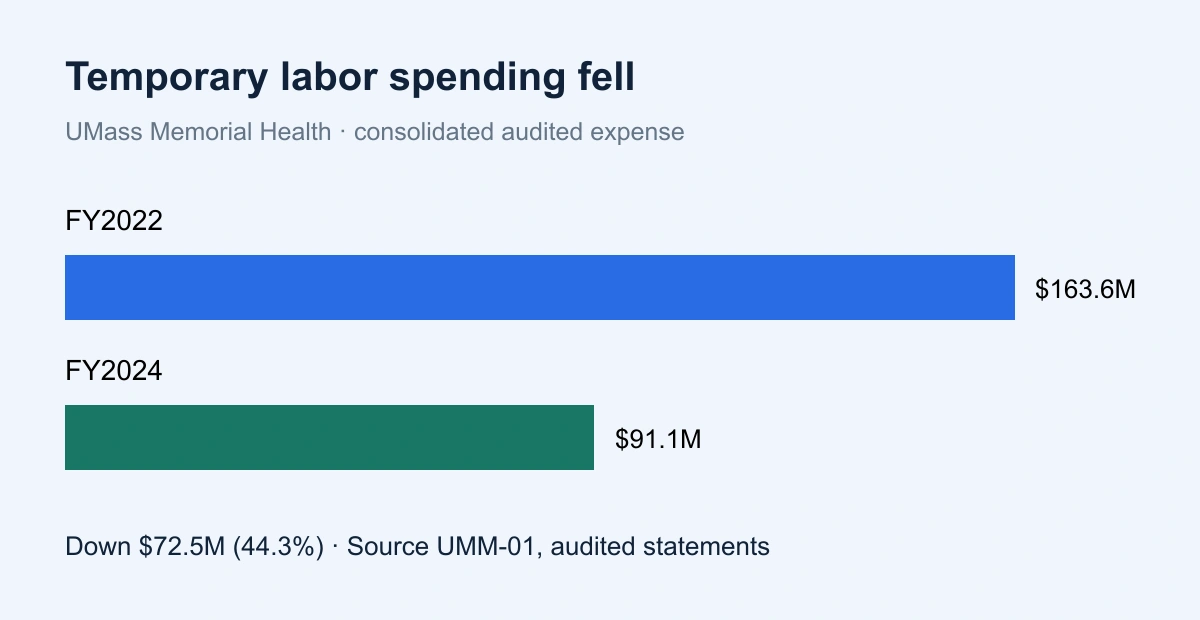
Temporary labor fell from $163.6M in FY2022 to $91.1M in FY2024, consistent with conversion to permanent hiring. That saving may already support wages or inflation; an allocation bridge is missing.
The FY2024 group filing listed $102.349M to Vaya Workforce Solutions. That amount can include pass-through clinician pay and a different reporting perimeter; it is not the same measure as the audited temporary-labor expense.
The medical center reported 816 staffed beds, 93.9% occupancy, 137,108 ED visits, and 45,067 discharges in FY2024. CMS rated the CCN 3 of 5 stars.
The State Auditor said $6.201M of EOHHS grant spending could not be traced through accounting records. UMass Memorial disputed the interpretation; EOHHS said it found no evidence of inappropriate use.
CEO Eric Dickson's FY2024 total compensation was $3.915M, up 61.1% from 2019. The public-interest question is which financial, staffing and safety results the board rewarded.
Operating margins are thin; temporary-labor reductions accompanied permanent recruitment.
Publish the savings allocation and vendor rate cards so workers can see what changed at the bedside.
Look at the record
How it unfolded
Temporary labor peaked at $163.6M.
Operating income was $25.2M; temporary labor fell to $91.1M.
Milford Regional joined through a no-consideration control transfer.
A state audit disputed documentation for $6.2M of workforce-related grant spending.
Six-month system operations were negative while total results remained positive.
University Campus nurses authorized a possible strike; authorization was not a strike date.
Check it yourself
Start with the visual PDF. Go deeper only where you want to. These files belong to this investigation, not a combined hospital report.
Earlier research editions retain their original dates; the visual reader above carries the August 27 compilation.
FY2024 / 2025 issue · Consolidated system and obligated group · Appendix A and audited statements
Supports: Operations, liquidity, investments, debt, temporary labor, related parties
Open source ↗FY2024 and six months FY2026 · System and Worcester Medical Center · UMMHC/UMMMC rows
Supports: Margins, liquidity, beds, occupancy, payer mix, utilization
Open source ↗FY2024 · IRS group return · Parts VII/IX and Schedules H/I/J/L/R
Supports: Contractors, CEO pay, grants, community benefit, related entities
Open source ↗2025 · Selected grants and payments · Finding 1 and response
Supports: $6.2M documentation dispute and counterevidence
Open source ↗Current reviewed release · CCN 220163 · UMass Memorial Medical Center row
Supports: Rating and identifier
Open source ↗Cutoff 2026-07-14 · System and Worcester entities · Local file
Supports: Sources, calculations, workforce, capital, quality and gaps
Open source ↗Published August 27, 2026. Historical records keep their original reporting periods. Read our methodology.